Does SEO Still Work? What Client Data Actually Shows
Estimated reading time: 9 minutesutes

Category: AEO & GEO, SEO
Search is no longer just about ranking ten blue links on Google. Customers now use Google AI Overviews, voice search, ChatGPT, Gemini, Perplexity, and other AI-powered tools to find answers, compare businesses, and make buying decisions.
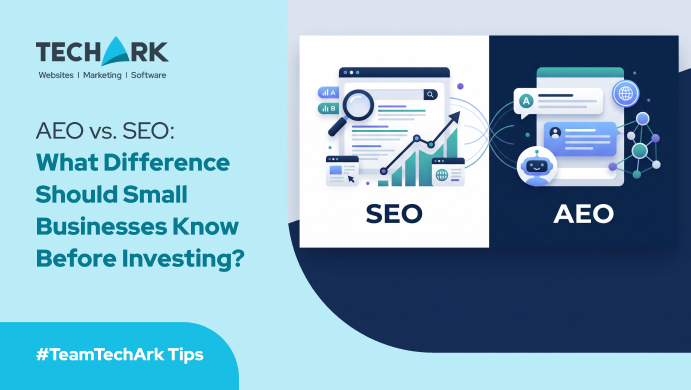
For small businesses, understanding AEO vs. SEO is important before deciding where to put your marketing budget. SEO helps your website earn visibility in traditional search. AEO helps your content become more useful and accessible to answer engines and AI-powered search experiences.
The good news? You do not necessarily have to choose one over the other. A strong strategy can use SEO as the foundation and AEO to prepare your business for the changing search landscape.
Table of Contents
SEO and AEO have similar foundations but different objectives.
SEO focuses on improving a website’s ability to rank for relevant searches and generate organic traffic. AEO focuses on providing clear, direct answers that search engines and AI systems can understand and potentially use in responses.
| Factor | SEO | AEO |
| Primary goal | Improve rankings and organic traffic | Improve visibility in direct answers |
| User behavior | Search and click | Ask and receive an answer |
| Content focus | Keywords and search intent | Questions and concise answers |
| Visibility | Search results and local pack | AI answers, featured answers and citations |
| Key metrics | Rankings, clicks, traffic and leads | Mentions, citations and AI visibility |
These strategies overlap. In fact, many of the practices that support AEO are already part of good SEO.
Google states that websites appearing in AI Overviews and AI Mode still need to meet its fundamental Search requirements. There is no special technical shortcut that guarantees an AI citation.
AEO, or answer engine optimization, is the process of structuring content so search engines, AI systems, voice assistants, and answer engines can better understand and use it when responding to questions.
Think about how customers search.
A traditional search might be:
“HVAC repair near me”
A conversational search might be:
“How do I know if my AC needs repair or replacement?”
The second query requires an answer, not simply a list of businesses.
That creates an opportunity for businesses that provide useful, specific, trustworthy information.
Effective AEO content can answer questions such as:
The goal is not to write for machines. The goal is to give people better answers in formats machines can understand.
Pro Tip: Review your sales calls, customer emails, FAQs, and support conversations. The questions customers ask repeatedly can become some of your strongest AEO content opportunities.
SEO is still the foundation.
A website cannot benefit much from AI search visibility if important pages cannot be crawled, indexed, or understood. Technical SEO, internal linking, useful content, site structure, and authority continue to matter.
A strong foundation includes:
This is why businesses should not abandon SEO simply because AI search is growing.
Instead, improve the existing SEO strategy so it supports multiple search environments.
For example, an existing service page can be enhanced with a direct answer, related questions, supporting evidence, clear headings, internal links, and relevant schema. One well-built page can then serve both traditional searchers and users interacting with AI-powered search.
Google AI Overviews can provide an AI-generated summary for certain searches and include links to supporting sources.
This changes how customers may discover businesses.
A potential customer might:
This is one reason zero-click searches matter.
A customer does not always need to click a website to become aware of a business. An answer, mention, or citation can influence the next step in the buying journey.
However, AI visibility should not become a vanity metric. A business should still evaluate whether increased visibility leads to qualified traffic, calls, inquiries, appointments, and revenue.
Note: Being eligible for AI search does not guarantee that a page will be cited. AI-generated results can vary based on the query, context, sources, and search system.
AEO for small business should focus on questions that have a genuine connection to products, services, and customer decisions.
Consider a local law firm. Instead of creating another generic page about estate planning, it could answer questions such as:
This approach addresses real search intent while creating useful content that can support multiple search formats.
The same principle works for:
Make sure important pages can be crawled and indexed.
Start with services, products, locations, and pages that already receive search traffic.
Build content around problems customers genuinely want to solve.
Keep your Google Business Profile, website, and other business listings accurate and consistent.
Connect related pages so users and search engines can easily find supporting information.
Track rankings, traffic, leads, calls, conversions, and emerging AI visibility signals.
Structured data/schema markup helps search engines understand specific information on a webpage.
Depending on the business and content, schema can describe:
Schema can support search understanding and eligibility for certain enhanced search features. However, it should not be treated as a guaranteed method for getting AI citations.
Google’s guidance makes this distinction clear. There is no special schema markup required specifically for AI Overviews or AI Mode.
Quick Fact: Google says pages need to be indexed and eligible to appear in Google Search to be eligible as supporting links in AI Overviews or AI Mode.
SEO vs GEO is another comparison businesses need to understand.
SEO, or search engine optimization, primarily focuses on improving visibility within search engines.
GEO, or generative engine optimization, focuses more broadly on improving how a business, brand, or information is represented in generative AI experiences.
A simple way to think about them is:
These strategies are not completely separate. Strong content, authority, accurate information, clear entities, and a technically sound website can support all three.
AI SEO should not mean publishing hundreds of AI-generated articles.
It means adapting an existing search strategy to the way people increasingly discover information.
A practical AI SEO strategy can include:
Businesses should also avoid creating content solely because it might be picked up by an AI system. Useful, original, trustworthy content remains the priority.
For businesses looking to strengthen their visibility across traditional and AI-driven search, AI SEO services can form part of a broader search strategy.
AEO vs SEO for small businesses should not be treated as an either-or decision.
Your starting point should depend on your website’s current condition.
| Current situation | Recommended priority |
| Website has indexing problems | Technical SEO |
| Website has little organic visibility | SEO + content |
| Important pages rank but lack useful answers | Add AEO |
| Customers frequently ask questions | SEO + AEO |
| Strong SEO foundation but limited AI visibility | AEO + GEO |
| Business relies heavily on local customers | Local SEO + AEO |
If your website has technical problems, solve those first.
If the foundation is already strong, AEO can be integrated into your existing content strategy without creating an entirely separate campaign.
That is the approach TechArk takes when helping businesses adapt their search strategy to traditional and AI-powered discovery: build on what already works, then add the optimization layers that match changing search behavior.
Search performance should be evaluated from both a marketing and business perspective.
The most important question is simple:
Is search visibility helping the business attract the right customers?
A higher ranking is useful. An AI citation can be valuable. But qualified leads and revenue ultimately determine whether the investment is working.
The most effective strategy is usually not SEO versus AEO versus GEO.
It is:
SEO foundation + AEO content + GEO visibility
For example:
Search intent → useful content → technical SEO → direct answers → structured information → authority → traditional visibility → AI visibility → customer action
A single strong service page can potentially support several of these stages.
If AI citations are a priority, How to Get Cited by ChatGPT, Gemini, and Perplexity: A GEO Playbook provides additional guidance.
The better question is not whether AEO will replace SEO. It is whether your business is prepared for customers who now move between traditional search results, Google Business Profile and local pack listings, AI Overviews, and conversational AI tools.
SEO gives your website the foundation it needs to be discovered. AEO helps turn useful information into clear answers. GEO addresses broader visibility in generative search.
For most small businesses, the smartest path is to strengthen all three progressively rather than chase the latest search acronym.
If your business needs help building a search strategy that combines traditional SEO with AEO, GEO, and AI search visibility, TechArk can help identify the right opportunities for your audience, website, and business goals through AEO services designed to support sustainable search visibility.
No. AEO complements SEO. Core SEO practices remain important for traditional search and Google’s AI-powered search experiences.
AEO means optimizing information so search engines, answer engines, and AI systems can better understand and use it when answering user questions.
It can be, especially when customers use conversational or question-based searches. It is most effective when built on a strong SEO and content foundation.
SEO focuses primarily on search engine visibility. GEO focuses more broadly on how businesses and information are represented within generative AI experiences.
There is no fixed timeline. Results depend on the website’s technical health, authority, content quality, competition, search behavior, and how AI systems select sources.