Does SEO Still Work? What Client Data Actually Shows
Estimated reading time: 9 minutesutes

Category: AI, SEO
Imagine this scenario: A potential customer asks ChatGPT or another AI search engine for a local business recommendation. The response? A competitor’s business website is featured. But your business? Nowhere to be found. Why? It’s because your website isn’t optimized for AI search.
As artificial intelligence becomes a primary tool for answering customer questions, businesses must adapt. AI search engines like ChatGPT, Google SGE, and Perplexity are not just providing links to websites; they’re giving direct answers. And the businesses that are cited are those whose websites are tailored to be found by these AI engines.
Understanding the differences between traditional SEO (Search Engine Optimization) and the newer AEO (Answer Engine Optimization) and GEO (Generative Engine Optimization) strategies is essential for any business owner. But how exactly do you ensure your website is ready for AI search visibility?
In this guide, we’ll walk you through the steps to ensure your website is prepared to appear in AI-generated search results, bringing your business to the forefront of this new search paradigm.
Table of Contents
AI search is a game-changer. Unlike traditional search engines, which display a list of links, AI search engines provide direct answers to user queries, often citing a select few sources. For example, when a customer asks an AI search engine like ChatGPT or Google’s SGE, “Where can I find the best local plumbers?”, AI engines pull information from trusted websites, synthesizing the response into a brief, concise format. The key here is visibility—being cited in that response.
Understanding how AI search engines function is essential to optimizing your business’s website.
AI Search Engines You Need to Know:
These AI search engines don’t just rank websites by keywords; they prioritize structured data, content clarity, and answer quality. If your site isn’t structured in a way that makes it easy for AI to access and cite relevant information, you risk losing visibility in this new search era.
AI search engines choose content based on its ability to directly answer user questions. They prioritize:
If your website isn’t designed to meet these requirements, AI search engines might not even consider it when generating answers.
In traditional SEO, ranking high on Google involves competing for a spot in the list of search results. However, with AI search engines, you aren’t competing for a ranking—you’re aiming to be cited. That means your website must be optimized to appear in the direct answers AI engines provide to user queries.
When it comes to optimizing your website for AI search, the terms SEO, AEO, and GEO will inevitably come up. These are three distinct but complementary strategies that businesses must understand in order to succeed in the age of AI-driven search.
SEO has been around for years and involves strategies designed to get your website to rank higher in search engine results. This includes optimizing for keywords, building backlinks, and improving on-page elements like meta descriptions and title tags.
AEO is a relatively new term in the world of digital marketing. AEO focuses on optimizing content specifically for AI answer engines like ChatGPT, Perplexity, and other conversational AI tools. It’s about ensuring your content can be cited directly by these AI engines in response to user queries.
GEO refers to optimizing your content so that it shows up in Google’s AI Overviews. Google SGE, for instance, generates summary responses that include AI-powered overviews at the top of search results. These summaries can include citations to businesses, and appearing in these overviews is crucial for visibility.
It’s crucial to understand the differences between traditional SEO and the newer strategies—AEO (Answer Engine Optimization) and GEO (Generative Engine Optimization). Let’s break down each strategy’s focus and key tactics to help you determine which approach is best for your business.
| SEO | AEO | GEO |
| Goal: Rank on search engines | Goal: Be cited by AI engines | Goal: Appear in Google’s AI Overviews |
| Platform: Google, Bing, etc. | Platform: ChatGPT, Perplexity | Platform: Google SGE |
| Key Tactics: Keywords, backlinks | Key Tactics: Direct-answer format, FAQ schema | Key Tactics: Structured data, authority signals |
To succeed in the evolving search landscape, all three strategies—SEO, AEO, and GEO—work together. SEO remains foundational, but AEO and GEO are now equally essential to ensure your website’s visibility in AI-generated responses.
Before diving into the steps to optimize your website for AI search, it’s important to first assess whether your website is even prepared for AI-driven search engines. AI search optimization requires a different approach than traditional SEO, and understanding where your website stands will help you prioritize the necessary adjustments.
Here’s a self-assessment checklist to help you determine if you’re on the right path to becoming AI search-ready.
AI search engines value:
Optimizing your website for AI search is no longer optional—it’s essential to ensure your business is visible to customers searching via platforms like ChatGPT, Perplexity, and other AI-driven engines. As AI search continues to grow, understanding how to improve your visibility in AI search results, including platforms like ChatGPT, and optimizing your website for these new search methods will be essential for staying ahead of the competition.
Here’s a step-by-step guide to ensure your website is optimized for AI search visibility.
One of the biggest shifts in AI search optimization is how AI engines prioritize content. Rather than focusing solely on keywords, AI search engines are designed to answer questions directly. To optimize your website for AI search, structure your content to answer common questions your customers are asking. This will increase the chances of being cited in AI-generated answers on platforms like ChatGPT, Google SGE, Perplexity, and other AI-driven search engines.
AI search engines prioritize content that is structured and easy to digest. One of the most effective ways to increase your chances of being cited is by adding a dedicated FAQ section. Additionally, mark up your FAQ section with the FAQ schema to make it easier for AI engines to pull information directly from your site. This will help you boost your visibility in ChatGPT and other AI platforms, increasing your website’s chances of being cited.
To ensure your content is AI-search-friendly, write in a direct-answer format. Start your paragraphs with the answer to the question, followed by a more detailed explanation if necessary. This is a key step to optimizing your website for AI search, as AI engines prioritize content that provides clear, direct answers.
Incorporating structured data is one of the most effective ways to improve your visibility in AI-driven search results. Use the FAQ schema for common questions, the HowTo schema for step-by-step guides, and the LocalBusiness schema if you’re a local business. Structured data makes it easier for AI search engines to understand the context of your content and boosts your chances of being cited in AI-generated responses.
AI search engines, particularly ChatGPT and Google’s SGE, value websites that demonstrate E-E-A-T (Experience, Expertise, Authoritativeness, and Trustworthiness). Add author bios, credentials, and citations to signal your site’s authority and increase its chances of being cited by AI engines. The stronger your E-E-A-T, the better your chances of showing up in AI search results.
Consistency is key in AI search optimization. Ensure your NAP (Name, Address, and Phone number) is consistent across your website and all external directories. This helps AI engines trust your website as a reliable source of information and increases the likelihood of your business being featured in AI-generated answers.
Getting cited by trusted sources is another critical factor in improving your chances of appearing in ChatGPT search results. AI search engines look for businesses that have been referenced or linked to by reputable sites. Focus on building backlinks from authoritative sources, getting featured in industry publications, and partnering with trusted entities. The more citations your website earns, the more likely it will be recognized by AI engines and cited in their responses.
Google AI Overviews optimization is a crucial aspect of AI search visibility for businesses. Google AI Overviews are AI-generated summaries that appear above traditional search results, providing users with direct answers to their queries. Optimizing your website to be featured in these summaries is an essential strategy for improving visibility.
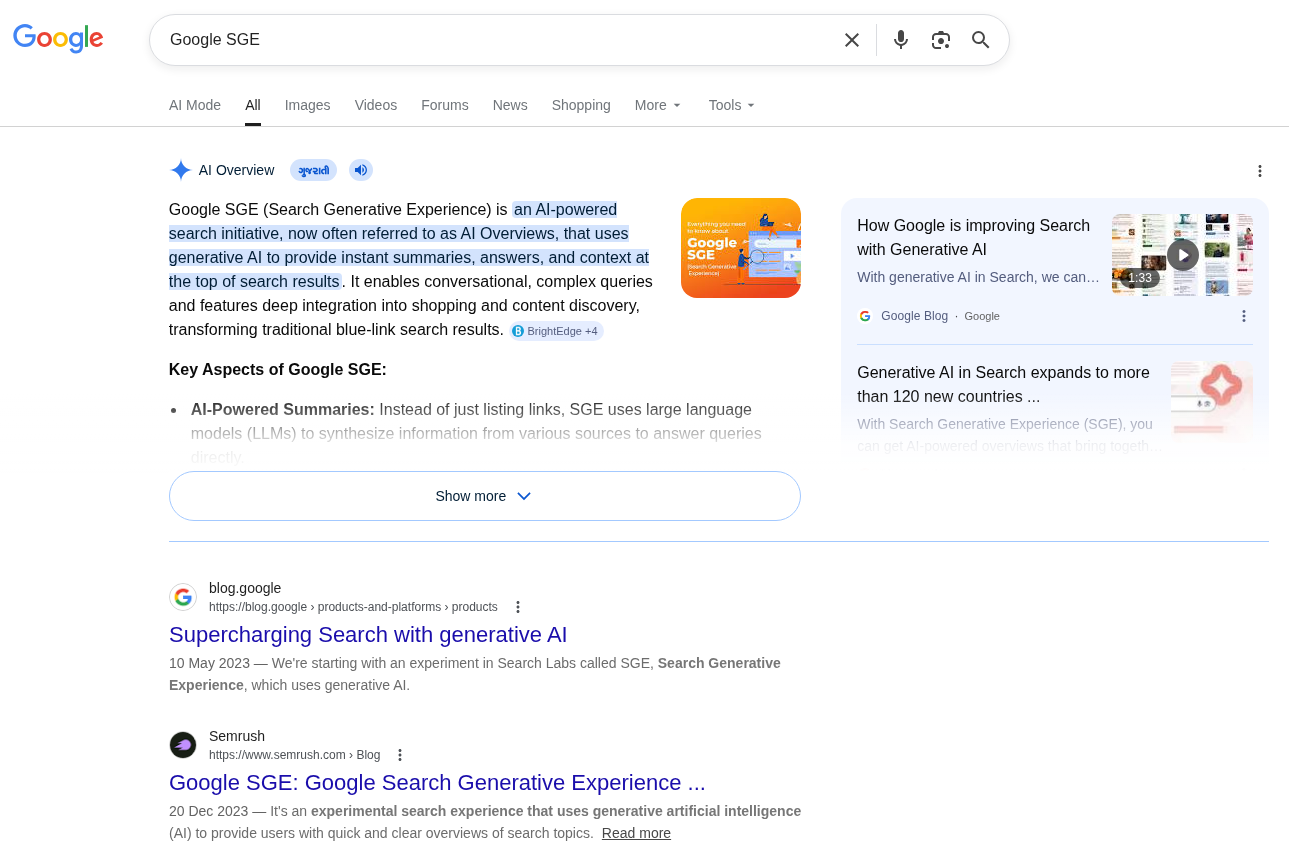
Google AI Overviews are short, AI-generated responses that appear at the top of Google’s search results, summarizing information from various sources. These overviews are typically generated by Google’s AI models and provide users with a concise, direct answer. Instead of sifting through multiple links, users can get the information they need instantly.
Google prioritizes websites that demonstrate authority, relevance, and clarity. Websites that provide direct, well-structured answers are more likely to be included in AI Overviews. Additionally, websites with strong E-E-A-T (Experience, Expertise, Authoritativeness, and Trustworthiness) signals and structured data (e.g., FAQ and HowTo schema) are more likely to be cited. If your website lacks these signals, it’s less likely to appear in these AI-generated summaries.
AI search optimization focuses on tailoring your website to be cited by AI engines like ChatGPT and Google’s SGE, whereas traditional SEO optimizes your site to rank higher in regular search results. Both strategies work together to improve your online visibility across AI and search engine platforms.
To get your business mentioned in ChatGPT answers, optimize your content for AI search optimization by using clear, direct answers to user queries, structuring your content with FAQ schema, and building authority through backlinks from trusted sources.
No, Google SGE (Search Generative Experience) doesn’t replace traditional search results but complements them by offering AI-generated overviews at the top of search results, providing users with a quick, direct answer from trusted sources like your website, if properly optimized for Google AI Overviews.
AEO (Answer Engine Optimization) focuses on optimizing content to be cited in AI answers, while GEO (Generative Engine Optimization) aims to enhance your visibility in Google AI Overviews. Both strategies are part of AI search optimization, but they target different aspects of AI search visibility.
The time it takes to see results from AI search optimization can vary, but typically you may start seeing improvements within a few months. The key is consistently implementing best practices like structured data and authoritative content to improve your chances of being cited by AI engines.
While basic AI search optimization can be done by business owners or content teams, some technical aspects, like implementing schema markups or improving website structure, may require a developer’s help to ensure full optimization for AI search engines like ChatGPT and Google SGE.
To succeed in AI search, the three biggest wins are: structuring your content for direct answers, using structured data like FAQ and HowTo schema, and building authority signals such as backlinks. These strategies ensure that your website is visible to AI engines and helps you appear in ChatGPT answers and Google AI Overviews.
We understand that most business owners don’t have the time or expertise to audit and optimize their structured data. That’s exactly what we do for our clients. At TechArk, we specialize in AI search optimization, helping businesses like yours navigate these complexities and ensure your site is ready for AI-driven search engines.
If you’re unsure where to start or need expert help, get a free AI search readiness audit today and see how you can boost your website’s visibility.