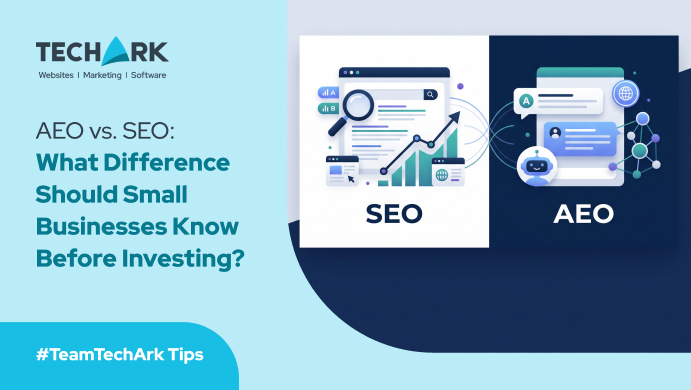
AEO vs. SEO: What Difference Should Small Businesses Know Before Investing?
Estimated reading time: 9 minutesutes

Category: AI, SEO
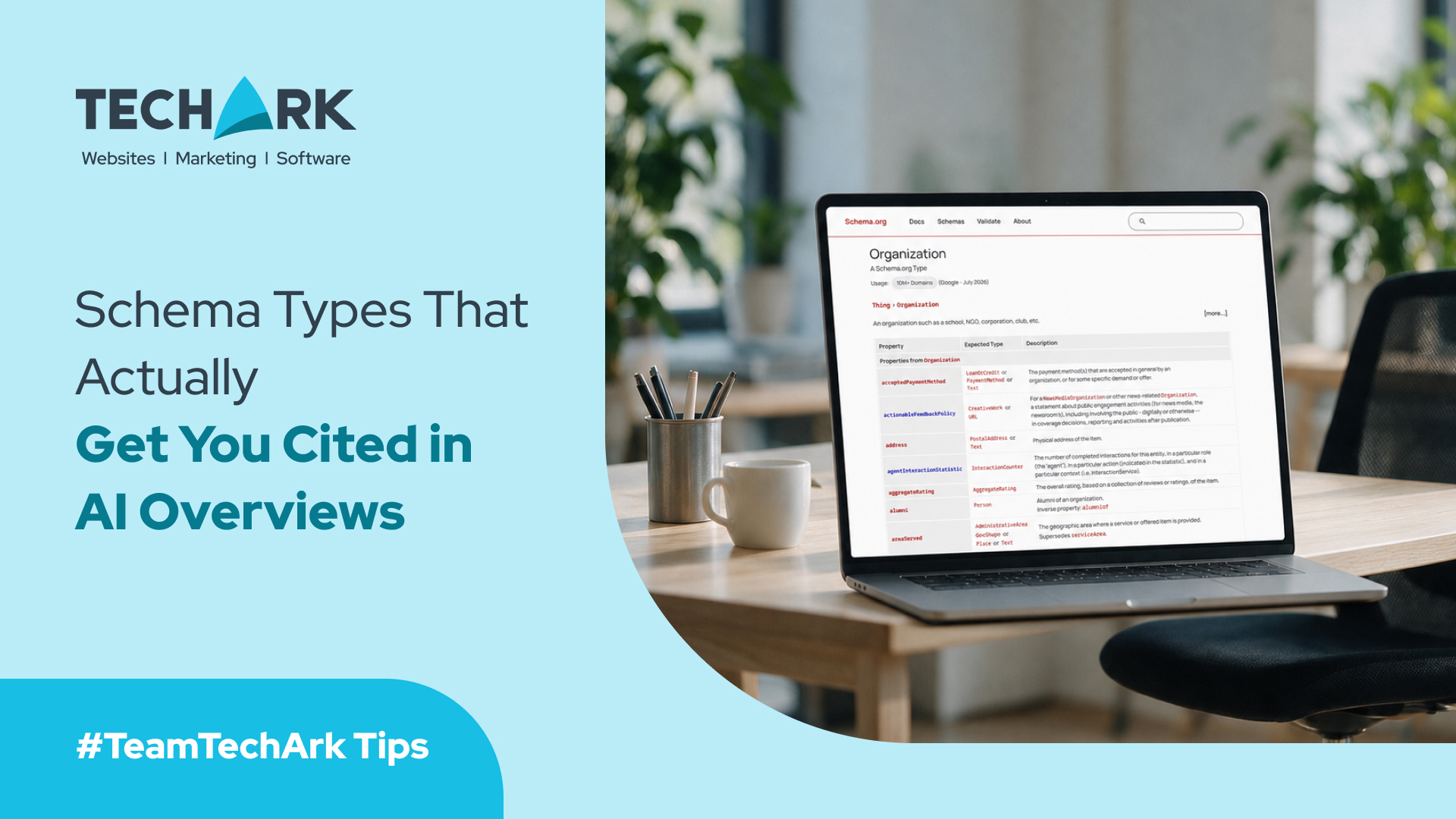
Schema markup for AI search gives search and answer engines clearer facts about your business, content, authors, services, and site structure. It can reduce ambiguity and support accurate extraction. It cannot guarantee a citation or rescue a weak, unindexed page.
A practical structured data for AI search plan starts with a few high-value types. Every field should match visible content, and related entities should connect through stable IDs.
Table of Contents
Schema helps machines interpret meaning, ownership, and context.
AI-generated answers must decide what a claim says, who published it, when it changed, and whether it fits the query. Schema labels those facts in a machine-readable format. It can separate an author from a publisher and a service from its provider.
A sound structured data AI Overviews plan improves clarity. It does not create automatic eligibility. Google states that no special schema is required for AI Overviews or AI Mode. A page must still be indexed and eligible to appear with a search snippet. Google also says structured data should match the visible page.
Quick Fact: Google says the same core SEO practices apply to its AI features, with no extra technical requirements for AI Overview eligibility. Schema supports understanding, but inclusion is never guaranteed. Source: Google Search Central.
Start with universal entity signals, then add markup that fits each page.
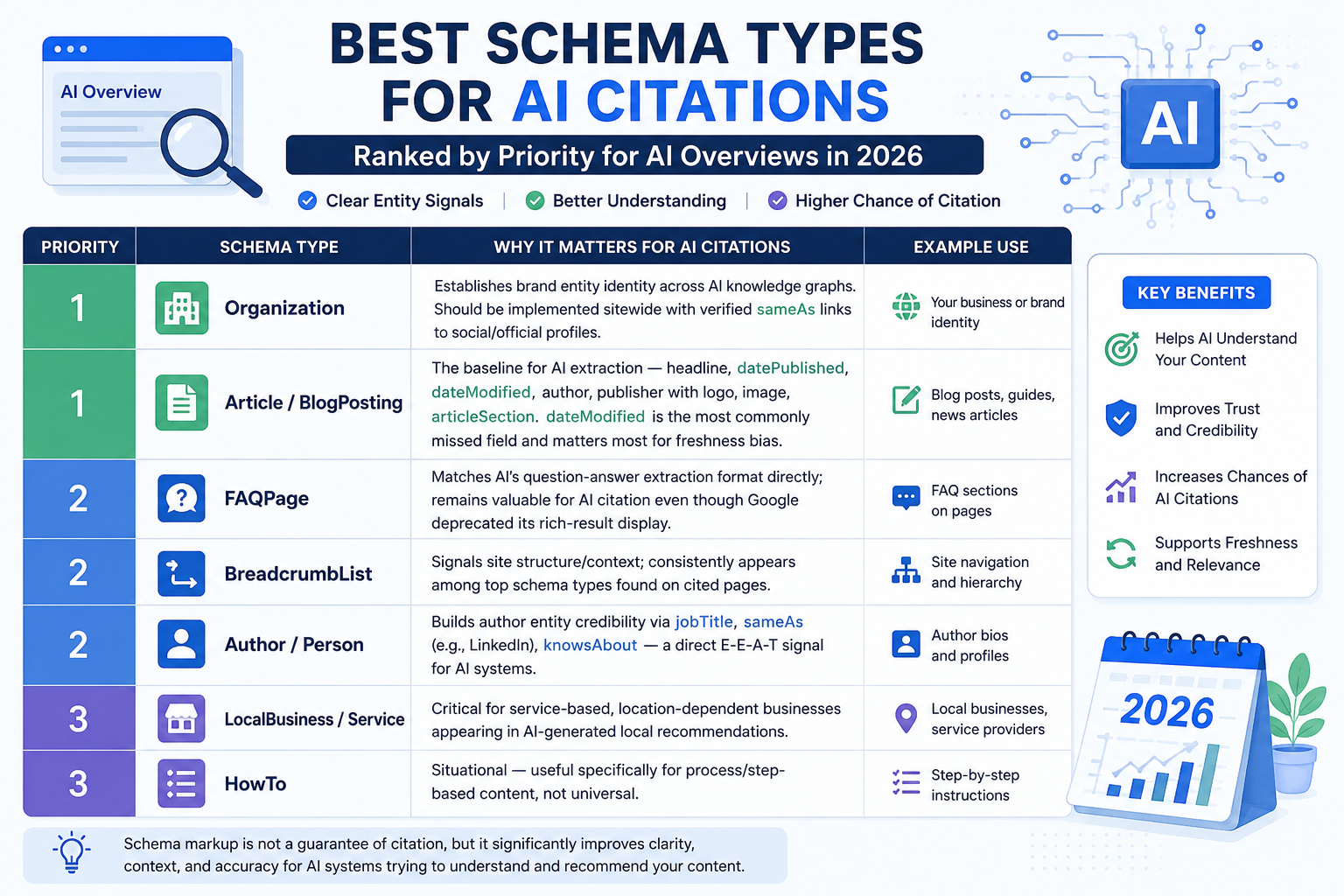
This markup defines the business and its official online presence.
Organization schema for AI search should use one consistent name, canonical URL, logo, contact details, and verified sameAs profiles. Create a stable @id, such as the homepage URL followed by #organization. Other objects can then reference the same entity.
Google says Organization markup can help distinguish one organization from another. It supports fields such as url, logo, and multiple sameAs links.
Pro Tip: Define the main Organization object once. Reference its @id from articles, services, authorship relationships, and locations.
Editorial pages should clearly identify the content, dates, author, and publisher.
For JSON-LD for AI search, include headline, datePublished, dateModified, author, publisher, image, articleSection, and mainEntityOfPage. The visible title, byline, and dates should agree with the markup.
Use dateModified only after a meaningful content change. Do not refresh it for a typo or an automated template update. Google recommends the property when publishers want to provide accurate modification information. Link each author to a real profile and the publisher to the Organization entity. Google also recommends url or sameAs to distinguish authors.
Use this type for genuine questions followed by complete, visible answers.
FAQPage schema no longer produces a Google FAQ rich result. Google ended the feature in May 2026 and later removed its FAQ rich-result documentation. The markup can still describe Q&A content for other systems, but it should not be added for a visual search benefit.
Every marked-up question and answer must appear on the page. Avoid hiding extra answers in the code. Choose questions that extend the topic rather than repeat earlier sections.
Breadcrumb markup shows where a page sits within the website.
A trail such as Home, Resources, AI Search, and Schema Guide creates a clear hierarchy. Google describes breadcrumbs as a way to indicate a page’s position in the site structure. Use canonical URLs and make sure the markup matches the visible navigation.
Author markup turns a byline into a defined and verifiable entity.
A Person object can include a real name, profile URL, role, relevant sameAs links, and focused knowsAbout topics. Connect it to the article through the author property. The profile should show experience, expertise, credentials, and published work.
Google recommends using url or sameAs to help distinguish authors. It also advises publishers to include every author displayed on the page within the structured data.
Do You Know? A byline connected to a detailed profile gives machines more context than an isolated author name.
These types explain what a company offers and where it operates.
Use the most specific LocalBusiness subtype available. Include the business name, address, phone, coordinates, hours, and canonical location URL. Google uses LocalBusiness fields to understand practical details such as opening hours, departments, and contact information.
Service markup should include serviceType, provider, areaServed, and a clear description. For TechArk and similar agencies serving local businesses, consistency is critical. Website pages and business listings should not show different names, phone numbers, hours, or service areas.
Use HowTo only when a user can complete a task through ordered steps.
Each step should be visible and useful. Google no longer supports HowTo rich results, but the schema vocabulary can still describe a real process. Do not force it onto service descriptions, opinion pieces, or general guides.
Specialized schema belongs after the foundation is complete.
Product and Offer suit ecommerce pages with real prices and availability. The event fits a unique event page. The course belongs on an actual course page. JobPosting belongs to one open role. Review markup must follow platform rules and should never misrepresent self-serving testimonials.
Research into schema markup AI citations supports a careful conclusion, not a promise.
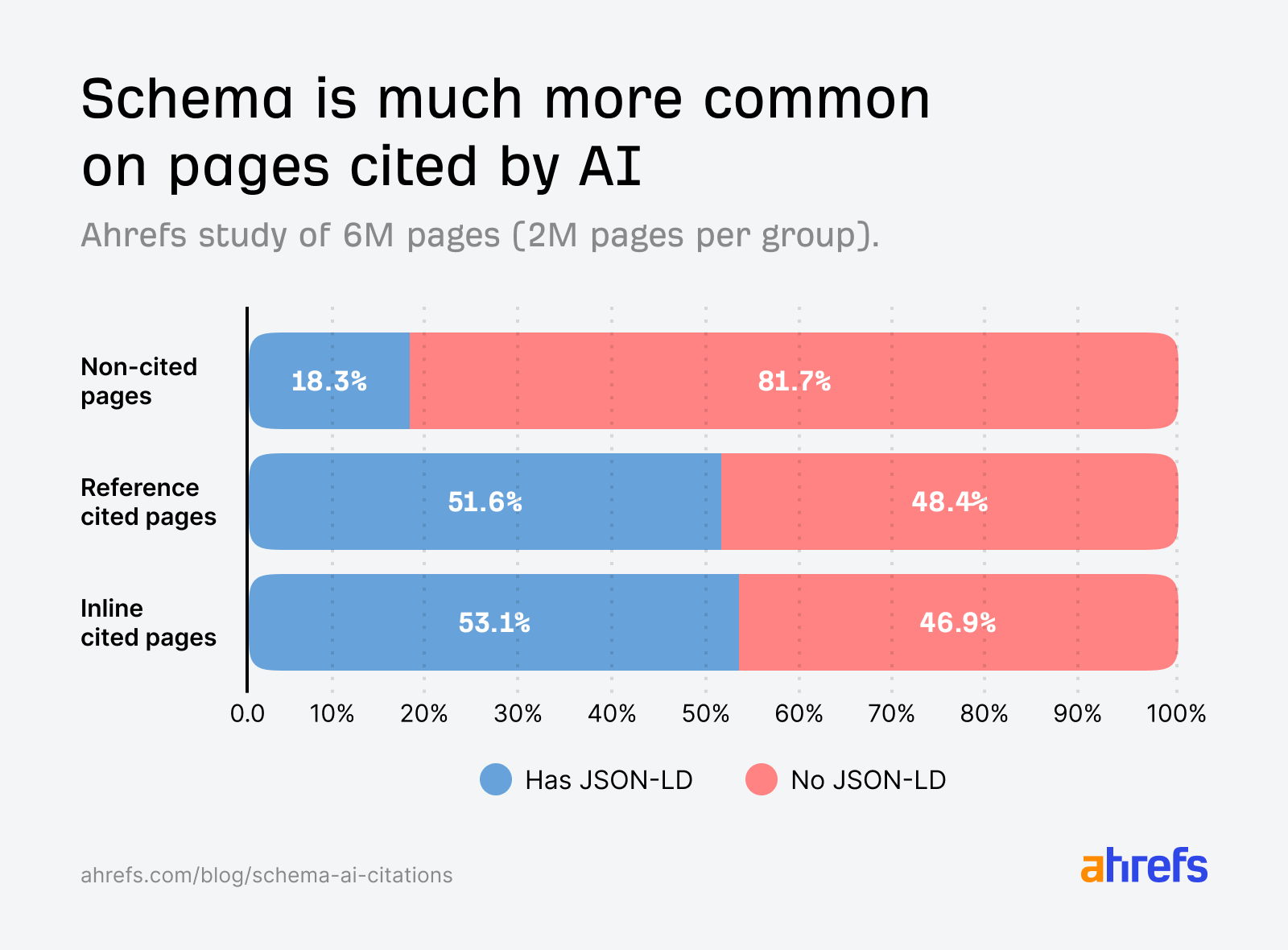
A 2026 analysis found that AI-cited pages were almost three times more likely to contain JSON-LD than pages that were not cited. That shows a strong correlation. It does not prove that schema caused the citation.
A controlled study tracked 1,885 pages that added JSON-LD and compared them with about 4,000 control pages. It found no clear citation growth in AI Mode or ChatGPT. It also found a small AI Overview decline that could not be confidently tied to schema.
Those pages were already receiving at least 100 AI Overview citations before the schema was added. The study therefore says less about pages with no existing AI visibility. It also grouped several schema types, so it could not determine whether individual types performed differently.
Other research summaries show positive relationships for Article, Organization, BreadcrumbList, and question-based markup. Outcomes vary by platform, page type, starting visibility, and research method.
The honest answer to how to get cited by AI Overviews is broader than code. Publish a crawlable page. Answer the query clearly. Add original facts where possible. Show who created the content. Keep it current. Use accurate schema so machines do not have to guess.
Most schema problems come from inconsistency, overuse, or incomplete entities.
Note: More markup is not always better. One correct type with complete and accurate fields is more useful than a large graph filled with vague or unsupported claims.
A layered rollout keeps implementation focused and maintainable.
| Page type | Recommended stack |
| Homepage | Organization, WebSite |
| Standard content page | WebPage, BreadcrumbList |
| Blog post or guide | Article or BlogPosting, Person, BreadcrumbList |
| Service page | Service, BreadcrumbList, Organization reference |
| Location page | LocalBusiness, Service, BreadcrumbList |
| Visible FAQ section | FAQPage |
| Process guide | HowTo |
| Product page | Product, Offer, BreadcrumbList |
Start with the entity layer. Cover high-value templates next. Add specialized types only when the content supports them.
A mature AEO schema markup program also needs clear ownership. Assign responsibility for business data, author profiles, modification dates, location details, and plugin changes.
An AI-Powered SEO Agency can connect schema, content, internal links, technical SEO, and measurement within one strategy.
Validation should cover syntax, visibility, eligibility, and consistency.
Run each template through the Schema.org Validator. Use Google’s Rich Results Test for schema connected to supported search features. Inspect the live URL in Search Console to confirm that Google can access the rendered markup.
After deployment:
A green validation result proves that the code is readable. It does not prove future rankings, rich results, or AI citations.
Schema works best as a clarity and consistency layer.
The best schema plan is focused, accurate, connected, and maintainable.
Schema for AI Overviews should not be sold as a guaranteed citation tactic. Current evidence is mixed. Its strongest value is removing ambiguity between a business, its experts, its content, and its services.
Use schema alongside useful writing, technical SEO, internal links, credible authorship, fresh facts, and third-party authority. That combined approach gives search and answer engines more reasons to retrieve and attribute your page.
These answers address the questions business owners and marketing managers ask most often.
Start with Organization, Article or BlogPosting, BreadcrumbList, and Person. Add LocalBusiness, Service, FAQPage, HowTo, Product, or Event only when the page supports that type.
It may improve machine understanding, but it does not guarantee visibility. Controlled research found little standalone uplift on pages that were already widely cited.
Neither platform publishes a universal schema priority list. Focus on clear entity and content markup, then track citations separately because platform behavior can differ.
Use stable entity IDs, accurate fields, linked author profiles, meaningful update dates, and page-specific types. Ensure every marked-up claim is visible and true. Validate the code and measure changes against a baseline.
Schema should support a complete visibility system.
Connect technical markup with answer-first content, expert authorship, site architecture, local accuracy, and ongoing measurement. Build a strategy around your goals, audience, and highest-value pages. Strengthen Your AI Search Visibility With TechArk.