
AEO vs. SEO: What Difference Should Small Businesses Know Before Investing?
Estimated reading time: 9 minutesutes

Category: AEO & GEO
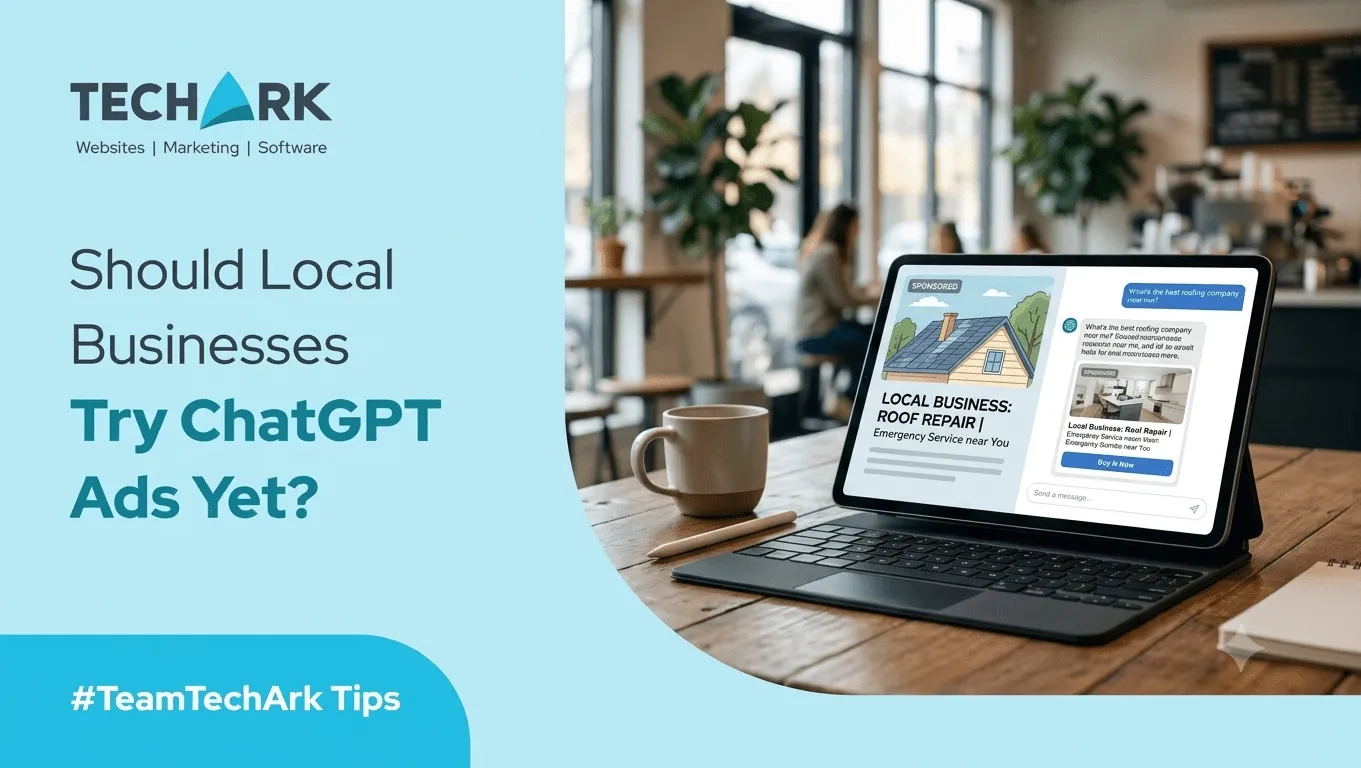
Imagine a homeowner asking ChatGPT, “What’s the best roofing company near me?” Along with a helpful answer, they might see a sponsored listing from a roofing company offering services in their area.
That’s the opportunity behind ChatGPT ads. Businesses can reach potential customers while they’re researching services, comparing options, and making purchasing decisions.
But should local businesses start spending money on this new advertising channel?
With OpenAI expanding its advertising platform in 2026, the opportunity is growing. Still, business owners need to understand the costs, targeting capabilities, and potential returns before investing.
Here’s what local businesses should know before deciding.
Table of Contents
ChatGPT advertising allows businesses to display paid promotions alongside relevant conversations. Unlike traditional search advertising, where users enter short keywords, ChatGPT users often describe their needs in detail.
For example, someone might ask:
These conversations provide context about customer needs, helping the advertising system identify potentially relevant promotions.
OpenAI ads began testing in the United States on February 9, 2026, initially reaching eligible adult users on Free and Go plans.
According to OpenAI’s October 2026 announcement, the platform has expanded to 89 countries, with more than 100,000 advertisers having run campaigns.
This expansion creates new opportunities for businesses to explore conversational advertising.
No. OpenAI maintains a separation between sponsored placements and organic responses.
According to OpenAI’s advertising principles:
Note: Paying for advertising does not guarantee that ChatGPT will organically recommend your business.
Business owners wondering what ChatGPT ads look like should understand that the experience differs from traditional search results.
Sponsored placements can appear below relevant ChatGPT responses, clearly separated from the main answer.
A typical advertisement may include:
Consider someone asking, “How do I find a reliable kitchen remodeling contractor?”
ChatGPT could explain how to compare contractors, evaluate portfolios, and request estimates.
Below that response, an eligible remodeling company might appear with an advertisement promoting design consultations.
This ChatGPT ads example illustrates how advertising could connect a business with someone researching a service. It is hypothetical, not a documented live campaign.
OpenAI has also introduced additional visual advertising tests, including formats associated with image generation.
Learn more about OpenAI’s advertising formats and measurement updates.
ChatGPT advertising creates another way to reach customers during their research journey.
Instead of relying entirely on traditional searches, businesses can potentially appear when users are actively discussing problems, exploring solutions, and comparing providers.
Quick Fact: According to BrightLocal’s 2026 research, 45% of consumers have used AI tools for local business recommendations, compared with 6% the previous year.
This shift suggests that AI-assisted discovery is becoming a meaningful part of local search behavior.
However, customers may still check Google reviews, explore websites, and compare services before contacting a business.
Consider the difference between these searches:
Traditional search: “Roof repair near me.”
Conversational search: “My roof started leaking after a storm. Should I repair it or replace it, and how do I find someone reliable?”
The second query provides more information about the customer’s situation.
Relevant advertising may help businesses reach users during this decision-making process.
BrightLocal’s Local AI Visibility Study found that AI business recommendations can vary significantly across repeated searches.
This means appearing organically in AI answers isn’t guaranteed.
Businesses should combine paid advertising experiments with strong website content, accurate business information, and consistent local SEO.
For additional insights, read TechArk’s guide on what marketing managers should know about AI search.
A common concern among business owners is how much ChatGPT ads cost compared with Google Ads.
Advertising expenses depend on campaign objectives, bidding, competition, and performance. There is no single guaranteed cost per click.
According to OpenAI’s official budget documentation, the standard ChatGPT ads minimum spend for a US campaign using a daily budget is $25 per day.
Here’s what different test budgets could look like:
| Testing period | Daily budget | Planned budget |
| 7 days | $25 | $175 |
| 14 days | $25 | $350 |
| 30 days | $25 | $750 |
| 30 days | $50 | $1,500 |
These figures illustrate budget planning, not guaranteed advertising costs or results.
OpenAI supports campaign objectives involving impressions, clicks, and conversions, with billing methods determined by campaign settings.
Suppose a remodeling company spends $750 and receives 15 inquiries.
Its cost per inquiry would be $50.
However, profitability depends on the number of qualified inquiries that become paying customers.
Pro Tip: Calculate your acceptable cost per qualified lead before launching. Consider your average project value, profit margin, and lead-to-customer conversion rate. This gives you a useful benchmark for evaluating campaign performance.
If you’re researching how to advertise on ChatGPT, eligible businesses can use OpenAI’s self-service Ads Manager.
The process involves five main steps.
Visit OpenAI Ads Manager and complete the required account, business, and billing information.
Confirm that your country and business category are eligible.
Select a goal that supports your business needs, such as website visits, service inquiries, or measurable conversions.
Describe the conversations and topics related to your offerings.
For example, a landscaping company might focus on backyard renovations, patio design, and outdoor improvements.
These context hints help guide ad relevance but do not guarantee placement.
Develop clear messaging that explains your service, its benefits, and the next action customers should take.
Direct visitors to a relevant landing page with a strong call to action.
After approval, track impressions, clicks, spending, and conversions.
For local businesses, qualified leads and acquired customers matter more than traffic alone.
Businesses considering ads on ChatGPT should compare the platform with their existing advertising channels before shifting budgets.
| Factor | ChatGPT Ads | Google Ads |
| User behavior | Conversational research | Keyword-based searches |
| Targeting | Conversation context and supported location settings | Keywords, audiences, and geographic targeting |
| Platform maturity | Emerging | Established |
| Measurement | Expanding capabilities | Mature tracking tools |
| Best opportunity | Research and discovery | Established purchase intent |
| Local business priority | Experimental channel | Often a primary lead source |
Google Ads remains a practical choice for businesses seeking immediate local inquiries.
For example, someone searching for “emergency plumber near me” may need help immediately.
Google’s established geographic targeting and conversion tracking make it especially useful for service-area businesses.
Explore TechArk’s Google Ads management services to understand how targeted search campaigns can support local lead generation.
AI advertising may suit businesses whose customers spend more time researching before purchasing.
Examples include:
These industries often involve detailed questions, multiple comparisons, and longer decision-making processes.
The right decision depends on your budget, website performance, and existing customer acquisition strategy.
Use this decision table as a starting point.
| Business situation | Recommended action |
| Existing campaigns generate profitable leads | Consider a small AI advertising test |
| Marketing budget is limited | Prioritize proven channels |
| Customers research extensively | Explore conversational advertising |
| Website conversion rates are poor | Improve landing pages first |
| Business serves a narrow geographic area | Verify available targeting options |
| Conversion tracking is missing | Set up measurement before launching |
Consider testing if:
Focus elsewhere first if your website needs improvement, current campaigns struggle to generate leads, or your business cannot track advertising results.
Do You Know? Paid placements and organic AI recommendations are separate. Advertising cannot guarantee that ChatGPT will recommend your business in its answers.
Advertising can help businesses gain exposure, but customers still need reasons to trust the companies they discover.
A strong website, useful content, and accurate business information support long-term visibility.
Local businesses should:
These improvements support traditional SEO and AI-driven discovery.
Instead of focusing exclusively on short keywords, develop content around real customer problems.
For example, an HVAC company could explain repair costs, replacement options, and signs of system failure.
This approach creates useful information for customers while strengthening topical relevance.
Read TechArk’s guide on how to optimize your website for AI search for practical recommendations.
Businesses seeking a broader strategy can explore TechArk’s AEO GEO Agency services to improve visibility across AI-powered search experiences.
A controlled 30-day pilot can help determine whether the platform deserves additional investment.
Choose one service, define your audience, establish a budget, and configure conversion tracking.
Make sure your landing page provides a clear path to contacting your business.
Review website visits and early engagement.
Check whether inquiries are relevant to your services and geographic coverage.
Avoid making major decisions based on very limited data.
Identify which inquiries represent genuine sales opportunities.
Evaluate customer needs, service-area relevance, and potential revenue.
Compare total spending with qualified leads and customer acquisition results.
| Metric | Illustrative result |
| Advertising spend | $750 |
| Website visits | 150 |
| Total inquiries | 12 |
| Qualified inquiries | 6 |
| Cost per qualified inquiry | $125 |
| New customers | 2 |
Figures are hypothetical and do not represent actual campaign performance.
If results look promising, consider extending the test. Businesses with longer sales cycles may need more time to evaluate profitability.
ChatGPT advertising presents an interesting opportunity, but it shouldn’t automatically replace proven marketing channels. For businesses already generating consistent leads, a small test may reveal new ways to reach potential customers. For businesses with limited budgets or underperforming websites, improving existing marketing efforts should come first. The goal isn’t simply to advertise on another platform. It’s to reach the right customers, generate qualified inquiries, and achieve measurable returns.
Ready to explore AI advertising opportunities for your business? Contact TechArk to develop a digital marketing strategy focused on qualified leads, stronger visibility, and measurable growth.
Yes. Eligible small businesses can create campaigns through OpenAI Ads Manager, subject to country availability, account verification, and advertising policies.
Geographic targeting capabilities depend on the options available within Ads Manager. Businesses should verify whether their required city or service-area targeting is supported.
They may be useful for services that involve research and comparison. However, actual effectiveness depends on targeting, customer intent, and campaign performance.
Yes. Eligible advertisers can create and manage campaigns through OpenAI’s self-service platform without hiring an agency.
A 30-day pilot offers an initial evaluation period. Businesses with fewer inquiries or longer sales cycles may need additional time before concluding.
