Contact Us
Send Us a Message
Need expertise and innovation on your project? Our team can help.
Have you ever asked ChatGPT, Gemini, or Perplexity a question and wondered why it mentioned one company but completely ignored another?
That result is not always random. AI tools seek information they can find, understand, trust, and use. Generative Engine Optimization (GEO) helps content meet those needs and earn mentions or citations.
As people use AI to research and compare options, these answers can introduce your brand at an important moment.
Nothing guarantees a citation. However, clear answers, credible sources, expertise, and a sound website can improve your chances. In this playbook, TechArk explains the practical steps businesses can take to improve their visibility across generative search platforms.
Table of Contents
What is Generative Engine Optimization?
Generative Engine Optimization is the process of improving your content so generative AI tools can find it, understand it, trust it, and use it when creating answers.
Traditional search engines usually provide a list of webpages. Generative engines can search for information, select useful details from different sources, and combine them into one response with links or citations.
For example, Google may show several webpages for “how to remove a coffee stain.” An AI assistant may instead build one step-by-step answer from several sources. If it uses and links to a laundry-care guide, that guide has gained visibility through GEO.
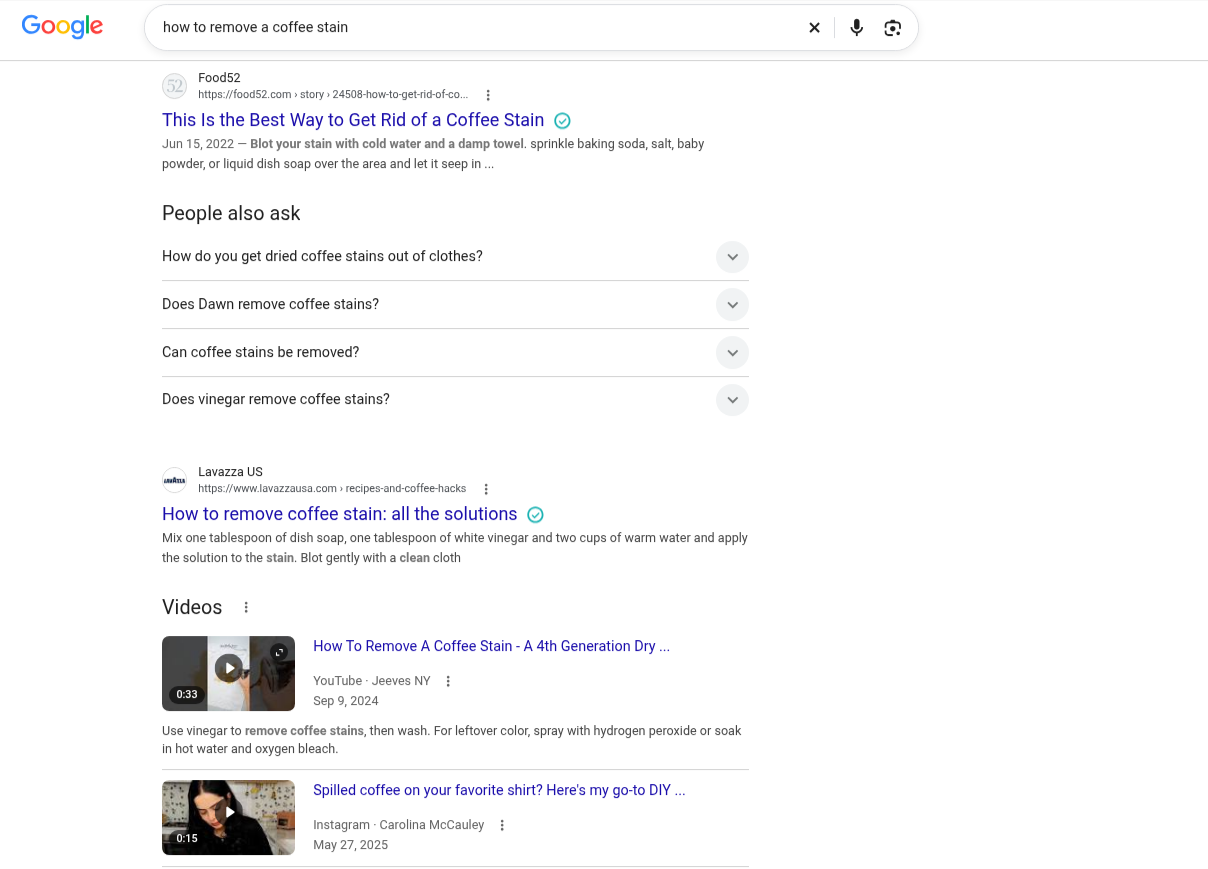
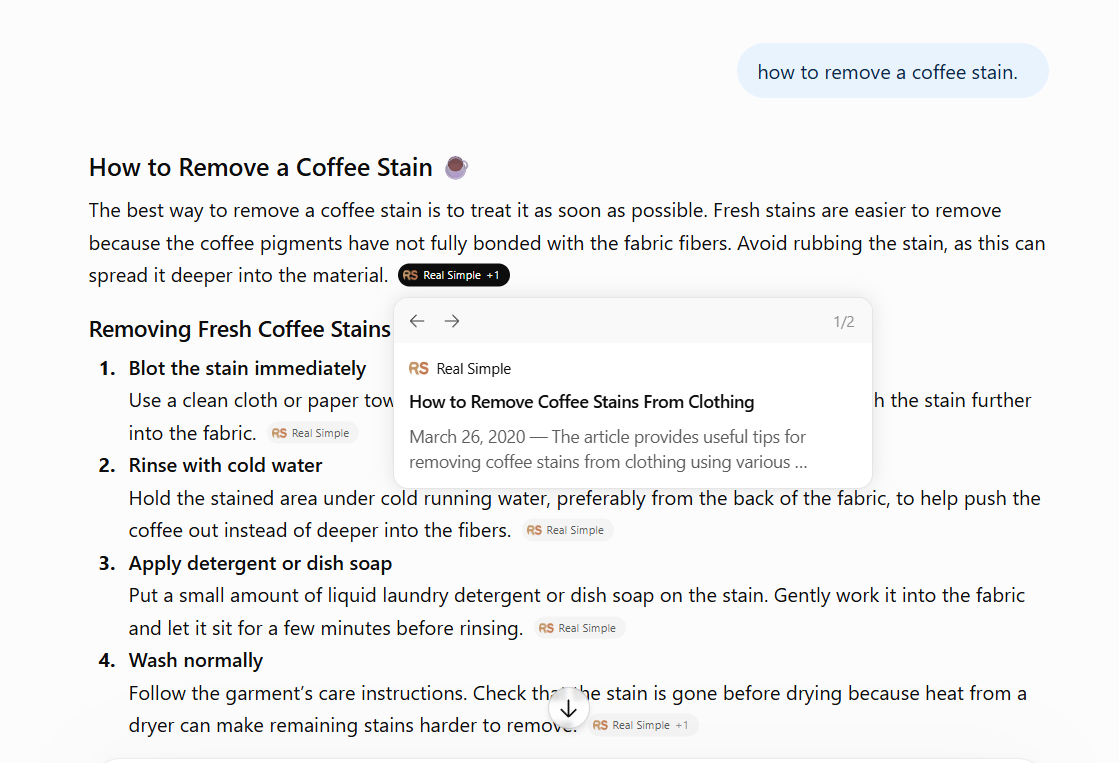
The goal is to make useful information clear, reliable, and easy for a generative engine to use.
Researchers from Princeton University, Georgia Tech, IIT Delhi, and the Allen Institute for AI introduced the term. Their 10,000-query study showed that writing and evidence can affect visibility in generated answers.
How is Generative Engine Optimization Different from SEO?
SEO helps your webpage appear higher in traditional search results, where users choose which link to open. Generative Engine Optimization (GEO) helps your content become part of an AI-generated answer through a citation, mention, summary, or recommendation. GEO builds on SEO fundamentals but gives more importance to direct answers, clear structure, original insights, and reliable evidence that AI tools can understand and use.
| Area | Traditional SEO | Generative Engine Optimization |
| Main goal | Rank higher in search results | Be used, mentioned, or cited in an AI-generated answer |
| What the user receives | A list of webpages and links | A direct answer created from selected information |
| What competes | A webpage or website | A fact, passage, webpage, or brand |
| Where information comes from | A search engine index | Search indexes, live web searches, and other available sources |
| Main measurements | Rankings, impressions, clicks, leads, and sales | Citations, mentions, AI visibility, referral visits, leads, and sales |
| Content focus | Quality, relevance, authority, and search intent | The same foundations, plus clear answers and reliable evidence |
GEO vs SEO should not be treated as a choice. Generative engines often use search technology. Ahrefs found that 76% of Google AI Overview citations in one study came from pages already ranking in Google’s top 10. Ranking does not guarantee citation, but strong SEO supports discovery.
Answer Engine Optimization (AEO) focuses mainly on short answers for snippets, voice search, and similar results. GEO is broader: it helps generative tools find, understand, use, mention, or cite content in complete responses.
In simple terms, SEO helps people find your webpage, AEO helps search platforms provide a quick answer from it, and GEO helps generative AI tools understand, use, mention, or cite it as a trusted source.
Why Are Brands Investing in GEO Now?
AI traffic remains small for many websites, but it may carry strong intent. On one site studied by Seer Interactive, ChatGPT visitors converted at 15.9% and Perplexity visitors at 10.5%, compared with 1.76% for Google organic traffic. This is not an industry average, but it shows the channel’s potential.
Ahrefs reported that AI search produced 0.5% of its visits but 12.1% of signups—a conversion rate 23 times higher than organic traffic. This company-specific result is not a promise, but it gives marketers a reason to measure AI visibility.
AI visibility should therefore be connected to your wider search strategy, not managed as a separate experiment. TechArk’s AI search optimization services bring content strategy, technical SEO, authority building, and AI visibility measurement into one coordinated approach.
How Do Generative AI Engines Choose What to Cite?
AI search tools often use retrieval-augmented generation, or RAG. The tool searches for information, retrieves possible sources, selects useful material, and creates an answer that may include citations.
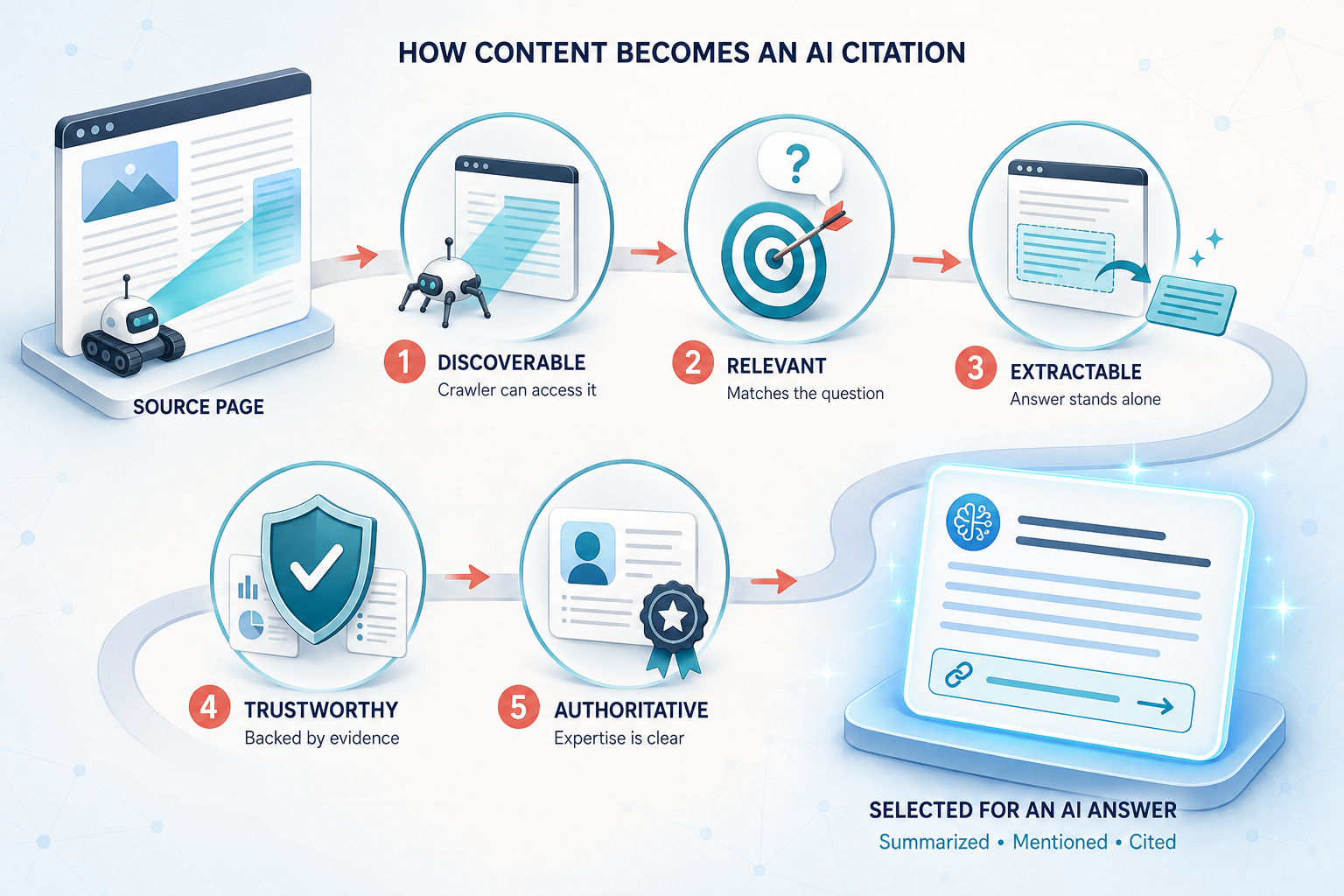
A page usually needs to pass several tests before it can appear in an AI answer:
- Can the platform find and access the page?
- Does the page answer the user’s actual question?
- Does it contain a clear section that makes sense on its own?
- Are its claims accurate and supported by credible sources?
- Does the author or brand appear trustworthy?
Being discovered is only the first step. The content must also be useful enough to select.
Signals That Influence Source Selection
AI companies do not publish their complete selection systems. However, these qualities can make a source more useful:
- Relevance: The content directly answers the question and covers its important details.
- Original value: The page adds experience, fresh data, expert insight, a tested process, or a decision guide.
- Trust: Reliable sources support claims, and the author and organization are clear.
- Freshness: Details that can change, such as laws, prices, features, and statistics, are kept current.
- Clear structure: Definitions, steps, and comparisons appear under descriptive headings.
- Technical accessibility: The page loads, works on mobile, and is not blocked.
- Consistency: Business details match across the website and trusted third-party profiles.
Simply repeating how to get cited by ChatGPT will not help. The content must provide a clearer or more useful answer than the other available sources.
Citation Differences Across ChatGPT, Gemini, and Perplexity
ChatGPT, Gemini and Perplexity choose different sources, each platform uses its own models, search systems, source preferences, and citation style.
Perplexity centers visible source links. ChatGPT may search the web for current information, though some answers have no citations. Gemini and Google AI Overviews can use Google Search yet choose different sources.
Ahrefs studied 76.7 million AI Overviews and about 1.9 million prompts across ChatGPT and Perplexity. Only seven of the 50 most-mentioned websites appeared in all three groups. That represents an overlap of just 14%.
This is why a strong Perplexity SEO result does not guarantee the same visibility in ChatGPT, Gemini, or Google AI Overviews and vice versa. Measure each platform separately.
How Do You Create Content That Generative Engines Can Cite?
Answer the reader’s question clearly, then provide the detail and evidence that make the answer trustworthy. Good GEO content helps people first while remaining easy for generative engines to understand.
#1 Give the Main Answer Early
The first 100–150 words should explain the topic, state the main point, and preview the value. Use the same approach in important sections. This is an editorial recommendation, not an official platform requirement.
#2 Use Clear Question-Based Headings
People often type complete questions into AI tools. “Does schema markup help GEO visibility?” is clearer than “Technical Considerations.” Question headings also improve scanning. They need a clear purpose, not an exact keyword.
#3 Write Short, Self-Contained Answers
Begin major sections with two to four sentences, usually 40–80 words, that make sense alone. Then add context, exceptions, examples, and sources where needed.
#4 Use Tables and Lists When They Improve Clarity
Use tables for comparisons, numbered lists for ordered steps, and bullets for requirements. No dependable evidence shows that a table automatically improves citations. Format for clarity, not as an AI shortcut.
#5 Support Important Claims With Reliable Evidence
Statistics, quotations, and citations provide facts that readers and generative engines can verify and attribute. In the original GEO study, the strongest tested methods improved source visibility by up to 40% in a controlled setting. Results varied by topic and query, so the finding supports evidence-based writing—not a guaranteed formula.
A statistic is helpful only when it is accurate, relevant, current, and supported by a credible source. Unsupported or outdated numbers can weaken trust.
There is no perfect citation count. Add a source when discussing:
- Statistics and research findings
- Laws and regulations
- Platform rules
- Market estimates
- Claims about how a named product works
- Time-sensitive industry information
Choose sources in this order:
- Use original research, official documents, laws, or first-party data whenever possible.
- Use a trusted secondary source when the original is unavailable or requires expert explanation.
- Avoid citing a blog that copied its information from another secondary article.
- Explain the date, sample size, and limitations when readers could mistake a specific result for a universal rule.
Place each source close to the claim it supports, and use the study, organization, or publisher as the anchor text. Review time-sensitive statistics whenever you update the article.
A Practical Example: From a General Claim to a Citation-Ready Answer
Consider a page answering the question, “Does schema markup improve AI visibility?”
| General claim | Citation-ready answer |
| “Schema markup is essential for GEO and can significantly improve your chances of appearing in AI answers.” | “Schema markup can help search systems understand a page, its author, and the organization behind it. However, it does not guarantee an AI citation. Google states that no special schema is required for AI Overviews or AI Mode, and structured data should match the content visible on the page.” |
The second version is stronger because it answers the question directly, avoids an unsupported promise, explains the limitation, and attributes the claim to Google’s official guidance. It also makes sense when read independently, making it easier for a generative engine to understand and reuse accurately.
A citation-ready paragraph improves the quality of an individual passage. However, generative engines may also consider the broader authority of the author, website, and brand.
How Do You Build Authority Generative Engines Can Trust?
Generative engines are more likely to trust content when expertise is clear, consistent, and supported by evidence. One strong article can help, but lasting authority comes from the complete picture your brand creates across its website, authors, and trusted third-party sources.
#1 Build Depth Around Your Core Topics
Publishing one article about a topic is rarely enough to establish authority. Create a connected group of resources that addresses the questions customers ask throughout their decision-making journey.
For example, a core service page can explain what your company offers, while supporting content can cover:
- Costs and timelines
- Service comparisons
- Implementation steps
- Common problems and solutions
- Case studies and measurable results
- Frequently asked questions
- Industry changes and original research
Connect these pages with relevant internal links. This helps readers explore the topic and shows search and generative engines how the information relates.
Avoid publishing several articles that repeat the same basic advice. Each resource should add something new, such as original data, a practical framework, campaign findings, a tested process, or lessons from client work.
#2 Strengthen Trust Through Independent Sources
Information published on your own website explains what your business does. Mentions from credible external sources help confirm your reputation and expertise.
Useful third-party signals may include:
- Genuine customer reviews and case studies
- Features in industry publications
- Memberships in professional associations
- Listings in trusted and relevant directories
- Research partnerships
- Conference presentations
- Expert comments in respected media
Focus on earning these mentions naturally. Publish research or insights that others may want to reference. Offer informed commentary to relevant journalists and publications. Keep important company details consistent across trusted profiles, and share client results only with permission.
The goal is not to collect as many mentions as possible. A small number of relevant, credible references can provide more value than many unrelated or low-quality links.
#3 Make Author Expertise Clear
Readers and generative engines need to understand who created the content and why that person is qualified to discuss the subject.
Include the author’s:
- Full name and professional role
- Relevant experience and qualifications
- Detailed biography
- Links to other credible work
- Publication or last-updated date
For technical, medical, legal, financial, or other specialist topics, identify the qualified reviewer when appropriate.
Author details alone are not enough. Expertise must also appear in the content. Include practical insights, limitations, exceptions, decision criteria, and lessons learned from real experience. This is more valuable than generic advice that could appear on any website.
These signals support E-E-A-T: experience, expertise, authoritativeness, and trust. E-E-A-T is not a single ranking score, but it is a useful framework for creating content that people and generative engines can evaluate with greater confidence.
What Technical Steps Improve GEO Visibility?
Even excellent content cannot appear in an AI-generated answer if the platform cannot access or understand it. A technically sound website makes it easier for search engines and generative AI tools to crawl, process, and evaluate your content.
A GEO-ready page should:
- Load without server errors
- Present its main content in clean HTML
- Work properly on mobile devices
- Use the correct canonical URL
- Be indexable by relevant search engines
- Remain accessible to the AI search crawlers you choose to allow
- Avoid hiding important information behind scripts or login screens
Technical optimization does not guarantee a citation. However, it removes barriers that could prevent strong content from being discovered or considered.
#1 Using Schema to Clarify Content and Entities
Schema markup gives search systems structured information about a page. It can clarify what the content covers, who created it, and which organization published it.
A business blog may use:
- Article or BlogPosting for the main content
- Person for the author or reviewer
- Organization for the publisher
- BreadcrumbList for the page hierarchy
Other types, such as Service, Product, or FAQPage, should only be added when the matching information is visible on the page and follows the relevant guidelines.
Google states that no special schema is required to appear in AI Overviews or AI Mode. Structured data can still help Google understand a page and make it eligible for relevant rich results when the markup accurately reflects the visible content. (Google Search Central)
Treat schema markup implementation as a tool for improving clarity—not as a switch that activates AI citations. Schema cannot make weak content authoritative, and valid markup does not guarantee that an AI platform will use the page.
#2 Managing Access for AI Crawlers
AI companies use different crawlers for search discovery, model development, and user-requested page visits. These crawlers do not all perform the same function, so review each one before changing your robots.txt file.
| Crawler | Main purpose | What businesses should know |
| OAI-SearchBot | Helps websites appear in ChatGPT search | Allow it if visibility in ChatGPT search is a goal |
| GPTBot | May be used to improve OpenAI’s generative models | Controlling it is separate from ChatGPT search discovery |
| PerplexityBot | Finds and links webpages in Perplexity search | Perplexity recommends allowing it for search visibility |
| Googlebot | Builds the Google Search index | Do not block pages you want eligible for Google Search or AI Overviews |
| Google-Extended | Controls certain Gemini training and grounding uses | It does not control Google Search ranking or inclusion |
OpenAI documents OAI-SearchBot and GPTBot as separate controls because they have different purposes. (OpenAI documentation)
Perplexity also separates PerplexityBot, which supports search discovery, from its user-requested page fetcher. (Perplexity documentation)
Google states that Google-Extended does not affect a website’s inclusion or ranking in Google Search. (Google documentation)
Crawler access should be reviewed as part of a wider technical audit. Also check:
- Firewall and CDN rules
- Bot-management settings
- noindex directives
- Canonical tags
- HTTP status codes
- JavaScript rendering
- Page speed and mobile usability
An open robots.txt file will not help if a firewall returns an access error, a page contains a noindex directive, or essential content is unavailable until JavaScript runs. The goal is to make important public content consistently accessible without exposing private, sensitive, or restricted information.
A Step-by-Step GEO Checklist for Your Next Blog Post
Use this checklist before publishing or updating an article.
Research
- Choose one main question. Define the reader, their goal, and the decision they need to make.
- Review existing answers. Check Google, ChatGPT, Gemini, Perplexity, and AI Overviews where available.
- Find the gaps. Look for missing details, weak explanations, old information, and unsupported claims.
- Plan original value. Add first-hand experience, original data, a useful framework, a template, or expert analysis.
Create
- Answer the question early. Explain the topic and main conclusion within the first 100–150 words.
- Use clear question headings. Give each section one purpose and avoid repeating the same keyword.
- Write self-contained sections. Start with a 40–80-word answer and then add context, evidence, and examples where needed.
- Support important claims. Connect statistics, platform rules, studies, and changing facts to primary sources.
- Use helpful formatting. Add tables for comparisons, numbered lists for steps, and bullets for quick points.
Validate
- Show who created the content. Add the author, reviewer, relevant experience, and update date.
- Keep business details consistent. Check the organization, services, authors, and locations across trusted profiles.
- Complete the SEO basics. Check the page status, indexing, canonical URL, internal links, mobile layout, speed, and HTML.
- Add an accurate schema. Mark up only information that readers can see on the page.
- Check crawler access. Review robots.txt, firewalls, CDN settings, and bot controls.
Measure and Improve
- Track a fixed set of questions. Measure citations, mentions, visits, leads, and sales on each platform.
- Keep the article current. Review dates, sources, platform features, and claims regularly.
This checklist can guide individual articles, but improving visibility across an entire website requires a consistent strategy. Explore TechArk’s AEO & GEO Services to see how content, technical accessibility, authority, and measurement can work together across your site.
How Do You Measure GEO Success?
Citation rate is the percentage of tracked questions for which an AI platform links to your site. Measure it with business outcomes because not every citation is accurate or valuable.
Build a fixed list of informational, comparison, location-specific, and buying questions. Record the platform, date, location, and answer because results change.
Which GEO Metrics Should You Track?
Track both visibility and business metrics:
- Citation rate
- Brand mention rate
- AI share of voice
- Most-cited webpages
- Citation accuracy and brand sentiment
- Referral visits from AI platforms
- Leads and sales
- Assisted conversions
- Branded search growth
- Traditional SEO performance
This prevents an inaccurate or ineffective citation from being counted as success.
Which Tools Track AI Visibility?
Ahrefs Brand Radar, Semrush, Profound, and other GEO platforms track mentions and citations. Choose based on platform, location, prompt, and reporting coverage.
Do not rely only on a third-party visibility score. Combine it with:
- GA4 referral traffic from platforms such as ChatGPT and Perplexity
- Google Search Console performance
- Verified AI crawler visits in server logs
- CRM lead and sales data
- Manual reviews of how the brand is described
What is a Good Citation Rate?
There is no universal benchmark. Results depend on the industry, question, platform, brand awareness, competition, and whether web search is used. Track 25–100 commercial questions more than once, separate branded from non-branded prompts, and compare the same set over time. Look for growth in accurate citations, qualified visits, leads, and sales.
Key Takeaways
- Generative Engine Optimization helps content become part of an AI-generated answer.
- SEO remains an important foundation because generative engines often use search technology to find information.
- Clear answers, original insight, and trustworthy sources make content easier to understand and cite.
- ChatGPT, Gemini, Perplexity, and Google AI Overviews may select different sources, so each platform should be measured separately.
- Schema can clarify a page, but Google says no special schema is required for its AI features.
- Search crawlers and model-training crawlers have different roles and should be reviewed separately.
- The best way to get cited by AI search engines is to publish information that deserves to be cited.
Frequently Asked Questions
1. How do I get my website cited by ChatGPT?
Answer specific questions, cite trusted sources, and demonstrate expertise. Allow OAI-SearchBot if ChatGPT search visibility is your goal. Earn relevant links and mentions, then track non-branded prompts. Nothing guarantees a citation.
2. How does Perplexity decide which sources to cite?
Perplexity selects sources that match the question, but its exact system is private. Relevant, current, well-supported, and accessible content can help. Perplexity recommends allowing PerplexityBot for search visibility.
3. What is the difference between SEO and GEO?
SEO helps webpages rank and earn clicks. GEO helps a brand or page appear inside generated answers. Both need useful content, authority, links, and technical SEO. GEO adds direct answers, reliable evidence, consistent entities, outside proof, and AI tracking.
4. Why isn’t my content showing up in ChatGPT answers?
ChatGPT may not search the web, access your page, or consider it the best source. Check indexing, crawler access, internal links, evidence, third-party mentions, and whether the question produces citations.
5. How do I structure content so AI chatbots quote it?
Use question headings and begin sections with direct answers. Add examples, lists, or tables when useful. Place reliable sources beside claims and include enough context to prevent misunderstanding.
6. Does schema markup help with AI search visibility?
Schema can clarify a page and its entities, but it does not guarantee citations. Google requires no special schema for its AI features. Use types that match visible information.
7. What is a citation rate in AI search marketing?
Citation rate is the share of tracked questions linking to your site. Five citations across 50 questions equal 10%. Define rules for repeat tests, branded prompts, webpages, and platforms.
8. Can small websites get cited by ChatGPT and Gemini?
Yes. A focused small site may answer better than a large general one. Specialized expertise, original research, named experts, and trusted mentions can help. Size alone does not determine value.
Make Generative Engine Optimization Part of Your Search Strategy
Getting cited by AI search takes more than changing a few headings. Your content, SEO, technical setup, brand authority, and reporting must work together.
If you need help identifying visibility gaps, prioritizing improvements, and creating a practical roadmap, talk to TechArk about a GEO strategy.