Contact Us
Send Us a Message
Need expertise and innovation on your project? Our team can help.
Search engines are becoming smarter every day. Google no longer looks only at keywords on a page. It now tries to understand the real meaning behind businesses, people, products, services, and locations.
That is where the Google Knowledge Graph becomes important.
The Knowledge Graph helps Google connect information across the web. It allows Google to understand that a business is not just a name on a website. It is an entity with services, locations, reviews, social profiles, leadership, expertise, and customer trust signals.
For business owners, marketing directors, SEO managers, and digital marketing teams, this shift matters. Stronger entity signals can help improve visibility across Google Search, Google Maps, Knowledge Panels, AI Overviews, voice search, and AI-powered platforms like ChatGPT, Gemini, Perplexity, and Bing Copilot.
In simple terms, the future of search is not only about ranking for keywords. It is about helping search engines understand who you are, what you do, where you serve customers, and why your business is a trusted source.
Table of Contents
What Is the Google Knowledge Graph?
The Google Knowledge Graph is Google’s system for understanding entities and the relationships between them. An entity can be a person, company, product, service, place, event, or concept.
Instead of reading the web as isolated pages, Google connects facts. This helps it understand meaning beyond keywords.
For example, Google may not simply see “TechArk” as a branded keyword. It can understand that:
- TechArk is a digital agency.
- TechArk provides SEO, digital marketing, website, software, and AI search services.
- TechArk is connected to Virginia.
- TechArk has business listings, social profiles, reviews, and service pages.
- TechArk creates content around SEO, AEO, GEO, websites, and digital growth.
Together, these signals help Google build a clearer entity profile. The stronger and more consistent that profile becomes, the easier it is for search engines and AI platforms to understand the business.
Pro Tip: The Knowledge Graph helps Google move from “matching words” to “understanding meaning.”
How the Google Knowledge Graph Works
The Knowledge Graph works by collecting, comparing, and connecting information from many sources. It looks for reliable patterns across the web to understand entities and relationships.
Understanding Entities
Entities are the building blocks of modern search. Common business-related entities include:
- People
- Companies
- Organizations
- Products
- Services
- Locations
- Brands
- Industry categories
For a business, Google may look at the company name, service pages, leadership information, location details, customer reviews, social profiles, and online mentions.
This supports Entity-based SEO, where the goal is not only to optimize one page but to build a stronger identity for the business across the web.
Understanding Relationships
The Knowledge Graph also studies how entities connect. These relationships help Google understand context.
| Entity Relationship | Example |
| Business → Offers Service | TechArk offers SEO services |
| Business → Located In City | TechArk is connected to Norfolk, Virginia |
| Person → Works For Company | A team member works for TechArk |
| Service → Supports Goal | SEO supports online visibility |
| Product → Manufactured By Brand | A specific company makes a product |
These relationships help search engines understand not just what your business says, but how your business fits into a larger topic, industry, and location.
Sources Google Uses
Google may use many sources to understand business entities, including:
- Website content
- Structured data
- Google Business Profile
- Social media profiles
- Industry directories
- Local citations
- Third-party mentions
- Review platforms
- Trusted websites
- Public data sources like Wikidata
This is why consistency matters. If your business name, address, phone number, services, or descriptions vary across platforms, it can weaken search engine confidence.
Why the Google Knowledge Graph Matters for Businesses
A strong Knowledge Graph presence can support better visibility, credibility, and search understanding.
Increased Search Visibility
Businesses with stronger entity signals may have more opportunities to appear in:
- Knowledge Panels
- Local Packs
- Featured Snippets
- Rich results
- Google Maps
- AI Overviews
- Branded search results
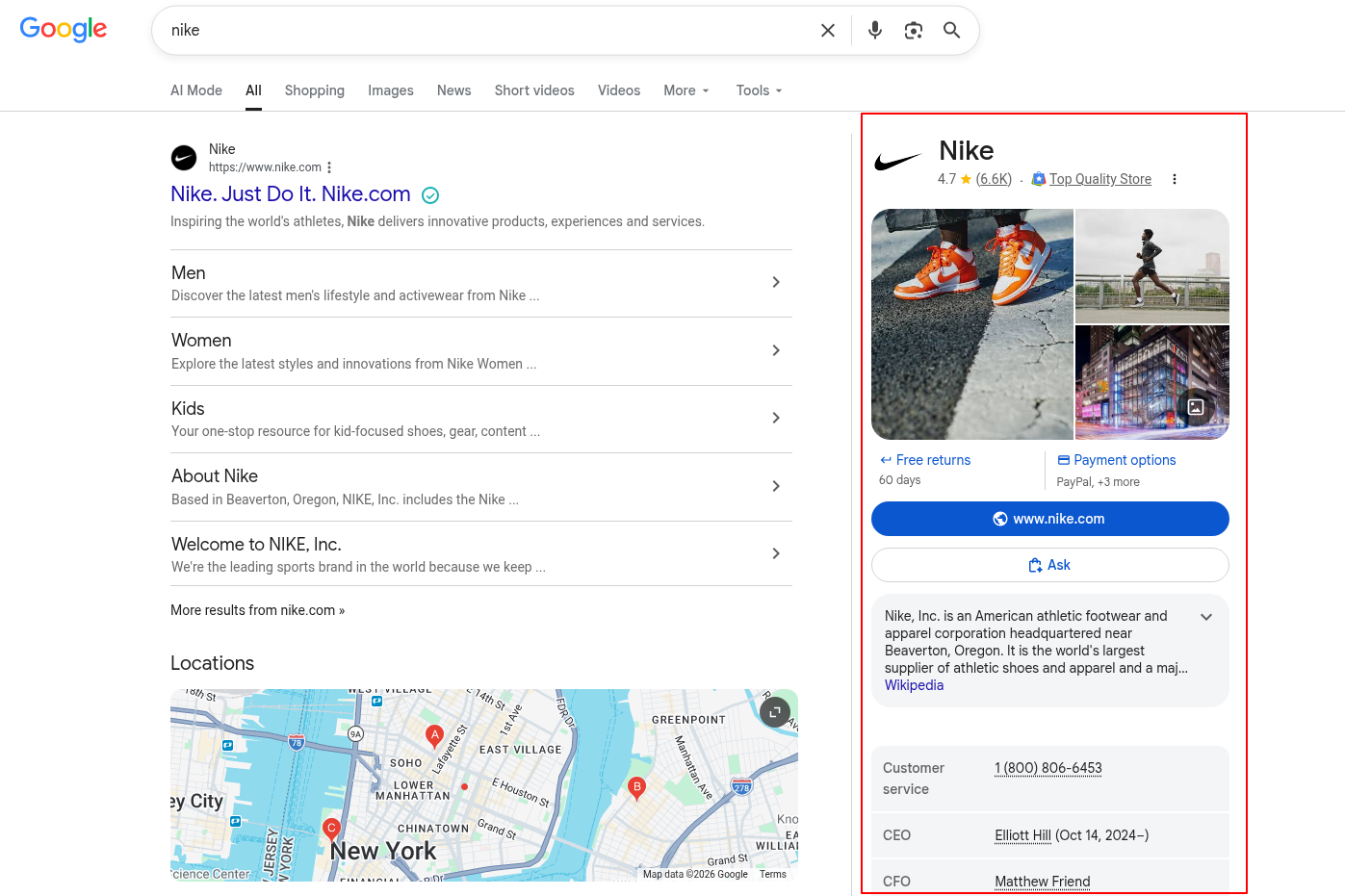
A Knowledge Panel is one of the most visible examples. It may appear when someone searches for a business, person, brand, or organization. It can show business details, social profiles, reviews, images, and other important information.
Stronger Brand Credibility
When Google can verify information across trusted sources, your brand appears more established. This can help users feel more confident before they click, call, or contact your business.
Credibility signals may include:
- Accurate business information
- Consistent listings
- Customer reviews
- Author bios
- Case studies
- Awards
- Certifications
- Media mentions
- Detailed service pages
Better Search Understanding
The Knowledge Graph helps Google better understand your:
- Services
- Expertise
- Industry focus
- Service areas
- Business category
- Team experience
- Topical authority
For example, a company that publishes helpful content about SEO, local SEO, technical SEO, content strategy, and AI search optimization sends stronger topical signals than a company with only one basic service page.
Improved Click-Through Opportunities
Visibility often grows before clicks increase. A user may see your business in search results, a Knowledge Panel, a local listing, or an AI-generated answer before they visit your website.
That visibility still matters. It builds recognition and trust over time.
Google Knowledge Graph vs Traditional SEO
Traditional SEO and entity SEO work together, but they are not the same.
| Traditional SEO | Entity SEO |
| Focuses on keywords | Focuses on entities |
| Optimizes individual pages | Builds brand-level understanding |
| Targets search rankings | Improves search understanding |
| Uses on-page content and links | Uses structured data, citations, and relationships |
| Measures clicks and rankings | Measures visibility, authority, and brand presence |
| Helps pages rank | Helps Google understand the business |
Note: Businesses still need keyword optimization, but keywords alone are not enough. Knowledge Graph optimization helps search engines understand the business behind the website.
How the Google Knowledge Graph Supports AI Overviews
AI-powered search is changing how people discover information. Google AI Overviews, ChatGPT, Gemini, Perplexity, and Bing Copilot rely on trusted information sources to understand topics, entities, and relationships.
This is where the Google Knowledge Graph, Entity SEO, and Semantic SEO work together.
The Knowledge Graph helps search engines understand who your business is and how it connects to services, locations, industries, and people. Entity SEO strengthens these signals through consistent and verifiable business information across the web.
Semantic SEO focuses on covering topics comprehensively rather than targeting individual keywords. By creating content around related concepts, questions, and user intent, businesses can build topical authority and demonstrate expertise.
AI systems use these signals to assess relevance and authority. Strong entity signals, structured data, trusted mentions, and comprehensive content can help AI systems better understand your brand and connect it to relevant topics.
Helpful signals include:
- Clear service pages
- Structured data
- Consistent business listings
- Expert-authored content
- Strong About and team pages
- Case studies and testimonials
- Mentions from trusted websites
- Connected social and business profiles
- Comprehensive topic coverage
In short, the Knowledge Graph helps search engines understand your business as an entity, while Semantic SEO helps them understand the topics and expertise associated with it. Together, they support visibility in both traditional and AI-powered search.
7 Ways to Improve Your Business Presence in Google’s Knowledge Graph
These practical strategies can help strengthen your business’s entity signals and improve Google’s understanding of your brand.
1. Implement Structured Data
Structured data helps search engines understand your content in a clear format. For businesses, useful schema types may include:
- Organization Schema
- LocalBusiness Schema
- Person Schema
- Service Schema
- FAQ Schema
- Article Schema
This helps Google identify your business name, logo, location, services, social profiles, and other key details.
2. Optimize Your Google Business Profile
Your Google Business Profile is one of the strongest local entity signals. Keep it complete and accurate.
Focus on:
- Primary and secondary categories
- Business description
- Services
- Hours
- Photos
- Reviews
- Questions and answers
- Appointment or contact links
- Location details
A well-maintained profile helps Google understand what your business does and where it serves customers.
3. Maintain Consistent Business Information
NAP consistency means your Name, Address, and Phone Number should match across the web.
Check your:
- Website footer
- Contact page
- Google Business Profile
- Social profiles
- Local directories
- Industry listings
- Review platforms
Even small differences can create confusion.
4. Build Authoritative Brand Mentions
Google looks beyond your own website. Mentions from trusted websites can strengthen your entity profile.
Good sources include:
- Industry publications
- Local media
- Business directories
- Guest posts
- Partner websites
- Chamber of commerce profiles
- Award listings
- Podcast or interview features
These mentions help confirm that your business is active, relevant, and credible.
5. Create Entity-Rich Content
Entity-rich content covers topics deeply and connects related ideas naturally.
For example, a digital agency may create content around:
- SEO
- Local SEO
- Technical SEO
- Content strategy
- Website design
- AI search optimization
- AEO
- GEO
- Digital marketing strategy
This helps build topical authority and supports Semantic SEO.
6. Connect Your Digital Properties
Your website should clearly connect to your important digital profiles.
These may include:
- YouTube
- Google Business Profile
- Industry directories
- Review platforms
- Partner profiles
Connected properties make it easier for Google to verify that these profiles belong to the same business entity.
7. Strengthen E-E-A-T Signals
E-E-A-T stands for Experience, Expertise, Authoritativeness, and Trustworthiness. These signals help users and search engines evaluate credibility.
Add or improve:
- Author bios
- Leadership pages
- Team credentials
- Awards
- Certifications
- Reviews
- Testimonials
- Case studies
- Client success stories
- Clear contact information
Strong E-E-A-T signals support both traditional SEO and entity visibility.
Signs Your Business Is Appearing in Google’s Knowledge Graph
While Google does not confirm Knowledge Graph inclusion directly, these signs may indicate that your entity is becoming better understood:
✓ A Knowledge Panel appears for your brand name
✓ Google correctly associates your business with relevant services, locations, or categories
✓ Your social profiles and official business listings appear in branded searches
✓ Rich results or enhanced search features appear for your website content
✓ Your business information remains consistent across Google properties
✓ AI-powered search experiences accurately recognize or reference your brand
The more of these signals you observe, the stronger your business’s entity presence is likely to be.
Common Mistakes That Limit Knowledge Graph Visibility
A few common issues can make it harder for Google to understand and trust your business entity:
- Incomplete or outdated business information across online platforms
- Inconsistent branding, contact details, or service descriptions
- Limited reviews, citations, or mentions from trusted third-party sources
- Thin content that does not clearly demonstrate expertise
- Poorly connected digital properties, such as websites and social profiles
Addressing these issues can help strengthen your entity signals and improve how Google recognizes your business across search experiences.
The Future of Search Is Entity-Based
Search is moving toward meaning, context, and trust. AI-driven search, voice search, semantic search, and knowledge-based search experiences all depend on clear entity understanding.
This is why SEO is expanding into:
- SEO: Search Engine Optimization
- AEO: Answer Engine Optimization
- GEO: Generative Engine Optimization
Businesses that want long-term visibility need more than keyword rankings. They need structured information, trusted content, consistent brand signals, and strong digital authority.
That is where a strategy partner like TechArk can help. Through SEO services, AI Search Optimization Services, and Digital Marketing Agency solutions, TechArk helps businesses improve visibility across traditional search, AI-powered search, and evolving digital discovery platforms.
Final Insights
The Google Knowledge Graph helps search engines move beyond keywords to understand businesses as entities. By connecting information about your brand, services, expertise, locations, and online presence, Google can build a clearer picture of who you are and what you offer.
As search continues to evolve, businesses that invest in structured information, strong entity signals, trusted content, and topical authority will be better positioned to improve visibility across both traditional and AI-powered search experiences.
FAQs
How does a business get into Google’s Knowledge Graph?
A business can improve its chances by creating clear website content, adding structured data, optimizing its Google Business Profile, maintaining consistent business listings, earning trusted mentions, and building strong topical authority.
What is the difference between a Knowledge Graph and a Knowledge Panel?
The Knowledge Graph is Google’s database of entities and relationships. A Knowledge Panel is a visible search result feature that may display information from the Knowledge Graph and other trusted sources.
Does structured data help improve Knowledge Graph visibility?
Yes. Structured data helps Google better understand business information such as name, logo, location, services, social profiles, and organization details. It does not guarantee visibility, but it supports clearer entity understanding.
Can small businesses appear in Google’s Knowledge Graph?
Yes. Small businesses can build entity signals through a complete Google Business Profile, consistent listings, structured data, reviews, local mentions, and helpful service-focused content.
How does the Knowledge Graph influence AI Overviews?
AI Overviews rely on trusted and clearly understood information. A stronger entity profile can help AI systems better understand a business, its services, and its authority. However, visibility in AI Overviews cannot be guaranteed.
Does a Google Business Profile affect Knowledge Graph visibility?
Yes. A complete and accurate Google Business Profile can support local search visibility and help Google understand important business details, including services, location, hours, reviews, and categories.
How long does it take to appear in Google’s Knowledge Graph?
There is no fixed timeline. It may take weeks or months for Google to collect, verify, and connect enough information. Consistency, authority, structured data, and trusted mentions can help support the process.
Ready to strengthen your visibility across Google and AI-powered search? TechArk can help your business build a smarter SEO, AEO, and GEO strategy designed for modern search behavior. Contact us now!