
Contact Us
Send Us a Message
Need expertise and innovation on your project? Our team can help.
Launching an app in four months sounds bold, but when the plan, team, and metrics align, the execution becomes predictable. This case study explains how we used a structured process, a focused tech stack, and clear KPIs to move from concept to store release in just 120 days using a strategy anchored around launching the mobile app in 120-day planning.
Why 120 Days Matter
Shipping an app within 120 days is not just about speed. It is about balancing focus, prioritization, and user insight from day one. Many product teams find the timeline achievable when they embrace outcomes over vanity features.
Pro tip: The fastest way to derail a 120-day release is scope creep. The fastest way to stay on track is a clear definition of “must ship” features.
Project Brief and Goals
Building a strong foundation early helps teams avoid friction later. Clear requirements, early UI definitions, and aligned KPIs create a shared direction.
- Goal: build and release iOS and Android MVP + admin console in 120 days.
- Team: product manager, two front-end developers, one backend developer, one QA, one designer, one release engineer.
Success metrics included retention, crash-free rate, and activation milestones linked to mobile app development timeline expectations.
High-Level Timeline (120 Days)
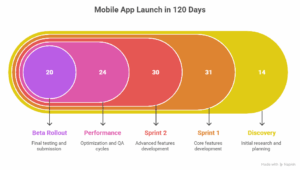
The timeline below reflects a realistic structure used by fast-moving product teams. It breaks the journey into five phases, each focused on output rather than task completion.
Here’s how the 120-day flow looked:
- Days 0–14: Discovery, rapid prototypes, user journeys, API contract definition.
- Days 15–45: Sprint 1 — authentication, core flows, data storage, offline basics.
- Days 46–75: Sprint 2 — push notifications, analytics, payments, third-party integrations.
- Days 76–100: Performance, accessibility, UI revisions, QA cycles.
- Days 101–120: Beta rollout, app store optimization, marketing prep, and final submission.
Industry guides confirm most standard apps fall within this timeline, with complexity as the main deciding factor.
Tech Stack (Why We Chose It)
Choosing the right technology determines how quickly the team can iterate. Our objective was reliability, speed, and a stack that could scale while staying nimble.
This was the reasoning behind each layer of our best tech stack for mobile apps 2025 choice:
Stack Overview:

- Flutter for mobile UI — single codebase, near-native performance.
- Node.js + Express for backend — fast, simple, and flexible.
- PostgreSQL for structured data — stable and scalable.
- Firebase for real-time features — ideal for chat, notifications, and device syncing.
- GitHub Actions + Fastlane for CI/CD — automated builds and store deployments.
Quick fact: Flutter’s rise continues into 2025 as teams prefer its consistent UI rendering and performance efficiency.
Development Process: Sprint Playbook
A strong process turns pressure into predictability. The goal was to promote delivery rhythm, reduce rework, and shorten decision cycles.
Our development approach supported this by aligning execution with cross-platform vs native mobile app decisions early.
Key Sprint Guidelines:
- Two-week sprints with clear definitions of done.
- Every commit passed automated tests and static analysis.
- Phased beta testing (internal → closed → open).
- App store preparation started 3–4 weeks before launch.
Do you know? Apple Search Ads provides a Search Popularity metric that helps choose high-value ASO keywords.
KPIs and Measurement
Measuring success early helps teams validate product fit. Tracking quality, usage, and retention gives evaluators immediate insight into performance.
These KPIs were built around industry standards and structured to emphasize mobile app KPIs to track across the entire lifecycle.
Primary KPIs:
- Daily and Monthly Active Users
- Day 1 / Day 7 / Day 30 retention
- Activation and conversion rates
- Churn rate
- Crash-free users percentage
- LTV and CAC alignment
Cohort analysis played a big role in understanding user patterns and shaping future roadmap decisions.
Results: What 120 Days Delivered
Results matter more than effort. By sticking to measurable KPIs and a fast iteration cycle, the team hit targets without last-minute crunch.
These outcomes also validated our early cost modeling based on how much does app development costs are forecasted.
Performance Snapshot:
- Beta release on Day 78
- Public launch on Day 120
- 7,200 downloads in the first week
- Day 7 retention at 28%
- Crash-free rate of 99.7%
“Shipping early, learning fast, and iterating with data beats shipping perfect code later.”
What Enabled the 120-Day Success
Shipping fast is a formula: disciplined scope, real-time communication, and data-backed decisions. The factors below helped maintain momentum across all four months.
Key drivers of success:
- Laser-focused MVP scope
- Tight cross-functional collaboration
- Strong CI/CD pipelines
- Analytics-driven onboarding optimization using mobile app KPIs to track
Teams that commit to clarity and speed rarely miss timelines.
Pro Tip: onboarding above everything. Improving the first-run flow almost always leads to an immediate rise in retention.
Final Words
This case study demonstrates how disciplined planning, the right stack, and data-centric execution make a 120-day mobile app launch realistic. Using modern frameworks like Flutter accelerates UI development, while optimized processes reduce delays. When teams track actionable KPIs and follow a structured mobile app development timeline, they set themselves up for a strong launch and compelling product story.
Key Takeaways
- A 120-day app launch is achievable with strict MVP discipline.
- Cross-platform tools accelerate development without sacrificing quality.
- Early KPI tracking improves product decisions and investor confidence.
- Strong CI/CD pipelines cut down approval and release delays.
FAQs
1. Can complex apps be shipped in 120 days?
Yes, but only as an MVP. Advanced real-time features, marketplaces, or large-scale social components may require phased releases.
2. Which is better for faster delivery: Flutter or React Native?
Flutter offers consistent rendering and faster UI development. React Native offers broader JavaScript ecosystem familiarity. Both are viable depending on team strength.
3. What KPIs matter most to investors and evaluators?
DAU, MAU, retention cohorts, crash-free rate, CAC, LTV, and churn. These indicators show both technical stability and user value.